


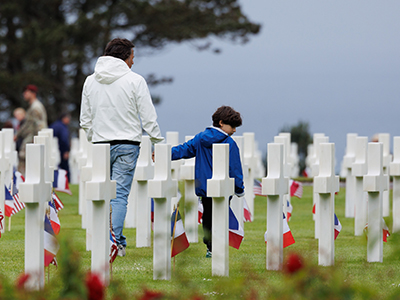
Normandy American Cemetery

Colleville-sur-Mer, France
Official websites use .gov
A .gov website belongs to an official government organization in the United States.
Secure .gov websites use HTTPS
A lock
or https:// means you've safely connected to the .gov website. Share sensitive information only on official, secure websites.
It contains the graves of 5,252 of our military dead, most of whom lost their lives in the campaigns across northeastern France to the Rhine River and beyond into Germany. The cemetery was established in October 1944 by the 46th Quartermaster Graves Registration Company of the U.S. Seventh Army as it drove northward from southern France through the Rhone Valley into Germany. The cemetery became the repository for the fatalities in the bitter fighting through the Saverne Gap, and in defense of Allied positions in the Vosges region, during the winter of 1944-1945.
The memorial, a rectangular structure with two large bas-relief panels, consists of a chapel, portico, and map room with a mosaic operations map. On the walls of the Court of Honor, which surround the memorial, are inscribed the names of 424 of the missing. Rosettes mark the names of those since recovered and identified. Stretching northward is a wide, tree-lined mall that separates the two large burial plots. At the northern end of the mall, the circular flagpole plaza forms an overlook affording a view of a wide sweep of the Moselle Valley.
On May 12, 1958, 13 caskets draped with American flags were placed side by side at the memorial. Each casket contained the remains of one World War II unknown American, each from one of the thirteen permanent American military cemeteries in the European theater of operations. In a solemn ceremony, Gen. Edward J. O’Neill, commanding general of the U.S. Army Communication Zone, Europe, selected the unknown to represent the European theater. It was flown to Naples, Italy and placed with unknowns from the Atlantic and Pacific Theaters of Operation aboard the USS Blandy for transportation to Washington, D.C. for final selection of the unknown from World War II. On Memorial Day, 1958 the remains were buried alongside the unknown from World War I at the Tomb of the Unknown Soldier at Arlington National Cemetery.
From mid-August to early September 1944, the U.S. Seventh Army and the French First Army moved quickly northeast from Southern France, linking up with the U.S. Third Army near Dijon on September 11. This strategic junction allowed for a coordinated push against German defenses.
With the formation of the U.S. 6th Army Group on September 15, consisting of the U.S. Seventh Army and the French First Army, operations intensified. Supported by strong tactical air support from the U.S. 9th Air Force and the French First Air Corps, the 6th Army Group advanced toward Germany, engaging in fierce combat through the fall and winter.
The final months of the war saw relentless battles, including the German counteroffensives of January 1945, the elimination of the Colmar Pocket in February, and the crossing of the Rhine in March. By late April, Allied forces secured major German cities, and by May 4, American forces linked up through the Brenner Pass. Victory in Europe was declared on May 8, 1945, marking the end of the war in the European theater.
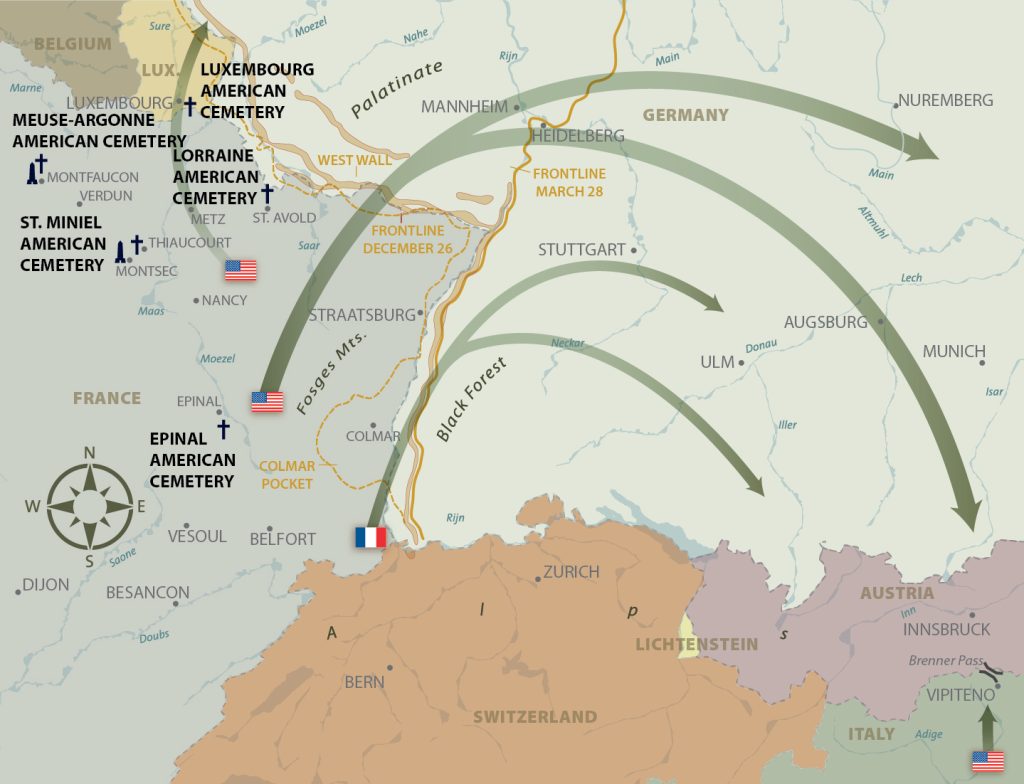
Epinal Map History
Vintage posters convey the beauty, tranquility, and solemnity of the place as a sign of respect for those who fought so that we can live free today.

Colleville-sur-Mer, France
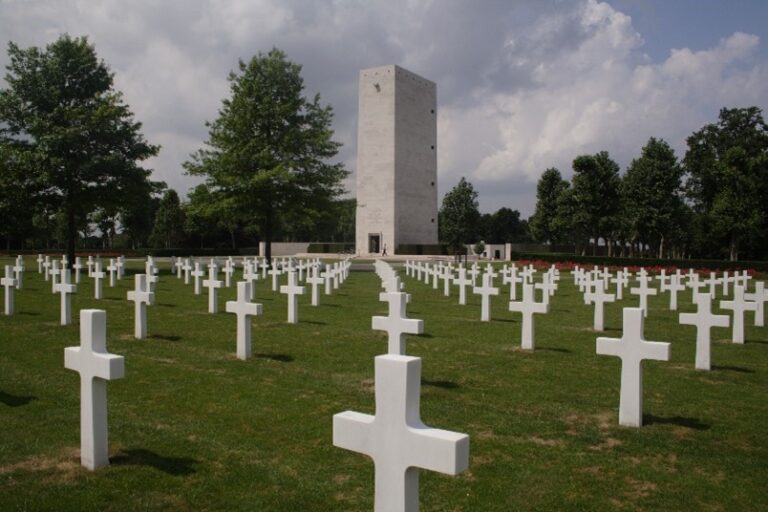
Margraten, The Netherlands

Taguig City, Philippines

ABMC.gov
official website of the American Battle Monuments Commission and a proud partner of The American Battle Monuments Foundation
Looking for U.S. government information and services? Visit USA.gov
