


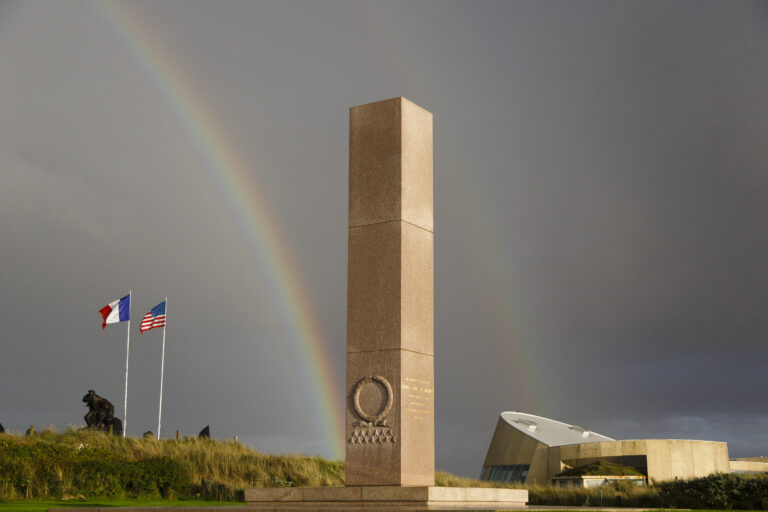
Utah Beach American Memorial

Utah Beach, France
Official websites use .gov
A .gov website belongs to an official government organization in the United States.
Secure .gov websites use HTTPS
A lock
or https:// means you've safely connected to the .gov website. Share sensitive information only on official, secure websites.
Between the two entrance buildings, a bridge leads to the burial area where the headstones of 4,392 of our military dead are arrayed in symmetrical curved rows upon the hillside. They represent 39 percent of the U.S. Fifth Army burials originally made between Rome and the Alps. Most died in the fighting that occurred after the capture of Rome in June 1944. Included among them are casualties of the heavy fighting in the Apennines Mountains shortly before the war’s end. On May 2, 1945 the enemy troops in northern Italy surrendered.
Above the graves, on the topmost of three broad terraces, stands the memorial marked by a tall pylon surmounted by a large sculptured figure. The memorial has two open atria, or courts, joined by the Tablets of the Missing upon which are inscribed 1,409 names. Rosettes mark the names of those since recovered and identified. The atrium at the south end of the Tablets of the Missing serves as a forecourt to the chapel, which is decorated with marble and mosaic. The north atrium contains the marble operations maps recording the achievements of the American armed forces in this region.
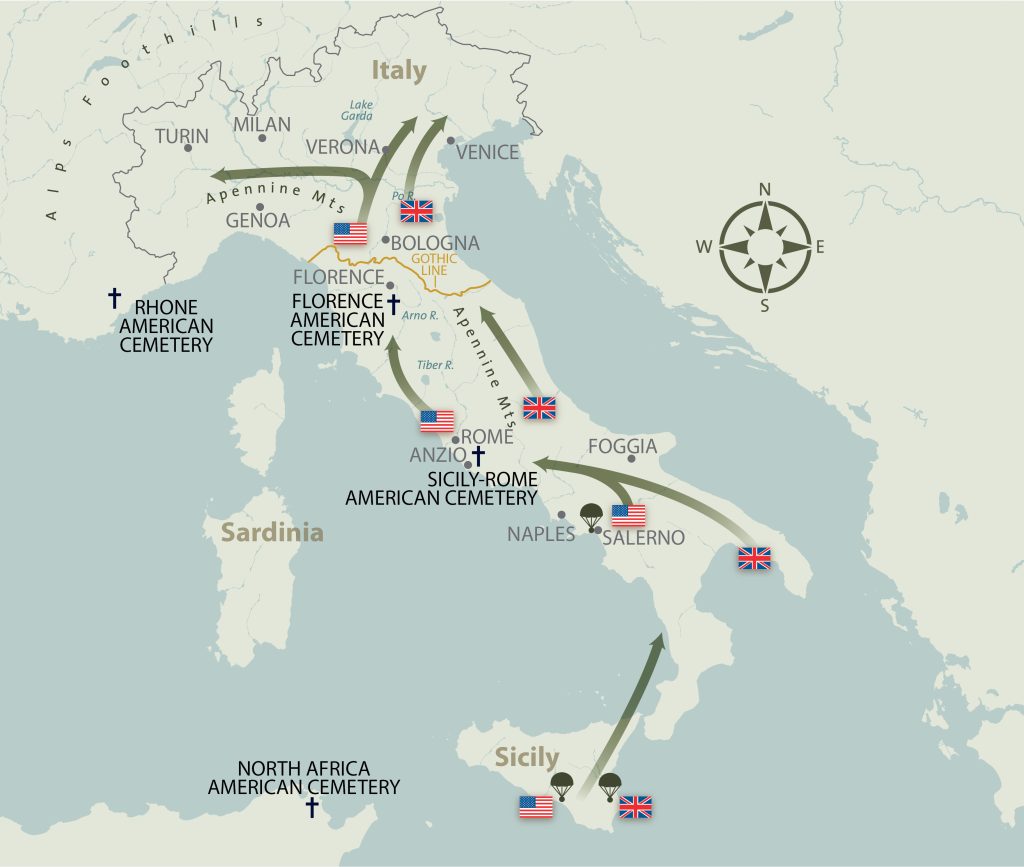
Their objective was the Gothic Line, a formidable German defensive position built along the rugged Apennine Mountains, separating central Italy from the Po Valley.
Despite fierce resistance and challenging terrain, the Allies made significant advances, capturing Florence and launching a major assault on the Gothic Line in late August. However, by mid-October, the offensive stalled south of Bologna due to personnel and supply shortages and the onset of severe winter conditions.
The final push to liberate northern Italy began in April 1945, with heavy air bombardment and renewed Allied ground offensives. By May 2, all German forces in Italy surrendered, marking the end of the Italian Campaign. The long and costly struggle not only liberated Italy but also contributed to the success of broader Allied campaigns in Europe.
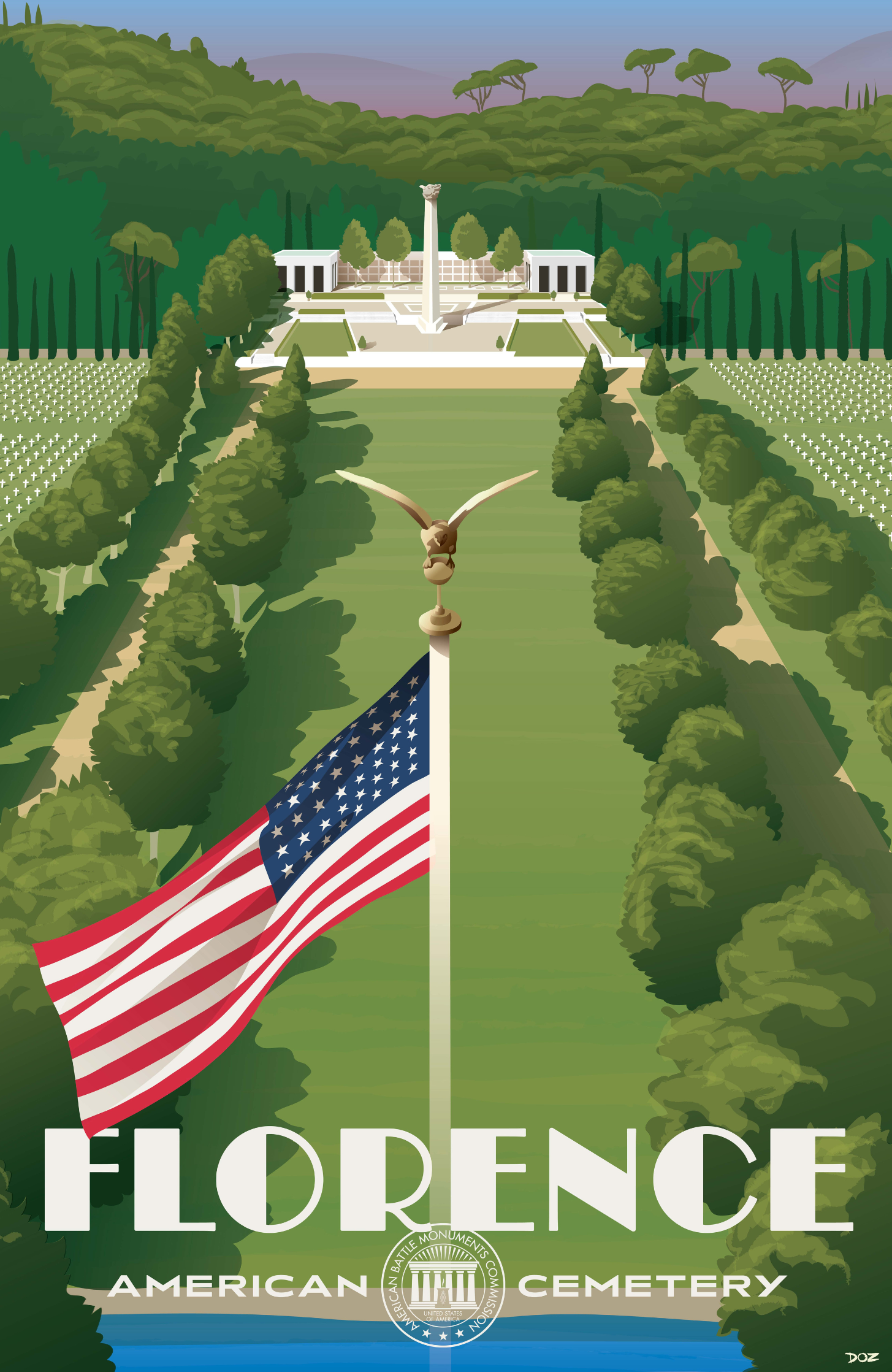
Vintage posters convey the beauty, tranquility, and solemnity of the place as a sign of respect for those who fought so that we can live free today.
Utah Beach, France

Luxembourg

Cambridge CB23 7PH, United Kingdom

ABMC.gov
official website of the American Battle Monuments Commission and a proud partner of The American Battle Monuments Foundation
Looking for U.S. government information and services? Visit USA.gov
