


Midway Monument

U.S. Outlying Islands
Official websites use .gov
A .gov website belongs to an official government organization in the United States.
Secure .gov websites use HTTPS
A lock
or https:// means you've safely connected to the .gov website. Share sensitive information only on official, secure websites.
Their headstones are arranged in nine plots in a generally elliptical design extending over the beautiful rolling terrain of eastern Lorraine and culminating in a prominent overlook feature. Most of the dead here were killed while driving the German forces from the fortress city of Metz, France toward the Siegfried Line and the Rhine River. Initially, there were over 16,000 Americans interred in the St. Avold region in France, mostly from the U.S. Seventh Army’s Infantry and Armored Divisions and its cavalry groups. St. Avold served as a vital communications center for the vast network of enemy defenses guarding the western border of the Third Reich.
The memorial, which stands on a plateau to the west of the burial area, contains ceramic operations maps with narratives and service flags. High on its exterior front wall is the large figure of St. Nabor, the martyred Roman soldier overlooking the silent host. On each side of the memorial, and parallel to its front, stretch the Tablets of the Missing on which are inscribed 444 names. Rosettes mark the names of those since recovered and identified. The entire area is framed in woodland.
Lorraine American Cemetery is less than one mile north of the town of St. Avold, France.
Throughout these operations, the Ninth Air Force and First Tactical Air Force provided crucial air support.
By November, both armies had made significant territorial gains, capturing Metz, Sarrebourg, and St. Avold, and preparing for the push into Germany. However, the Battle of the Bulge in December 1944 forced a shift in strategy, as Third Army quickly maneuvered north to counterattack the German offensive.
In early 1945, the Allies launched a final offensive into Germany. Third Army crossed the Rhine on March 9, and by late April, Allied forces had overrun much of southern Germany, liberating concentration camps and POW camps along the way. The war in Europe ended with Germany’s unconditional surrender on May 7, 1945, officially recognized on V-E Day (May 8, 1945).
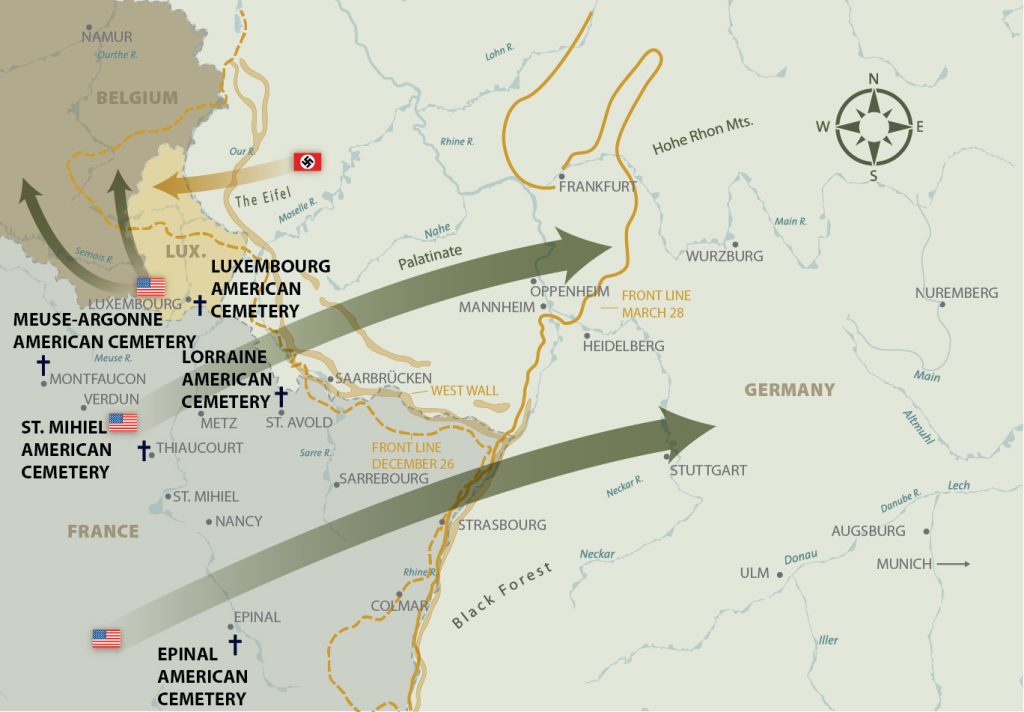
“From the Moselleto the Rhine and Onward”
Vintage posters convey the beauty, tranquility, and solemnity of the place as a sign of respect for those who fought so that we can live free today.

U.S. Outlying Islands

Draguignan, France

Taguig City, Philippines

ABMC.gov
official website of the American Battle Monuments Commission and a proud partner of The American Battle Monuments Foundation
Looking for U.S. government information and services? Visit USA.gov
