


Midway Monument

U.S. Outlying Islands
Official websites use .gov
A .gov website belongs to an official government organization in the United States.
Secure .gov websites use HTTPS
A lock
or https:// means you've safely connected to the .gov website. Share sensitive information only on official, secure websites.
It contains the largest number of graves of our military dead of World War II, a total of 16,859, most of whom lost their lives in operations in New Guinea and the Philippines. The headstones are aligned in 11 plots forming a generally circular pattern, set among masses of a wide variety of tropical trees and shrubbery.
The chapel, a white masonry building enriched with sculpture and mosaic, stands near the center of the cemetery. In front of it on a wide terrace are two large hemicycles. Twenty-five mosaic maps recall the achievements of the American armed forces in the Pacific, China, India and Burma. On rectangular Trani limestone piers within the hemicycles, are inscribed the Tablets of the Missing containing 36,286 names. Rosettes mark the names of those since recovered and identified. Currently, there are 439 rosettes found on the Tablets of the Missing at Manila American Cemetery and Memorial. Carved in the floors are the seals of the American states and its territories. From the memorial and other points within the cemetery there are impressive views over the lowlands to Laguna de Bay and towards the distant mountains.
On Oct. 19, 2019, the American Battle Monuments Commission (ABMC) officially opened a new interpretive visitor center at the Manila American Cemetery to honor the American and Filipino sacrifices during the fight for the Pacific in WWII. The dedication also marked the 75th anniversary of the return of Gen. Douglas McArthur to the Philippines.
Manila American Cemetery is located in the Global City, Taguig, Metro Manila, within the boundaries of the former Fort William McKinley.Please note that a valid photo ID is required for entrance to the cemetery. Drivers must follow a 20 km/h (12 mi/h) speed limit. Student drivers are not permitted to practice in the cemetery. Parking is available behind the chapel; bicycles must remain parked at the front gate for the duration of your visit.
Japan rapidly conquered vast territories across Asia and the Pacific but met fierce resistance in the Philippine Islands. The U.S. Army Forces Far East (U.S. Army, Philippine Army, and Philippine Scouts) held off Japanese assaults for six months, delaying Japan’s offensive plans and enabling the U.S. to begin counterattacks in the Pacific.
From 1942 to 1945, the U.S. launched a dual-pronged strategy to defeat Japan. General Douglas MacArthur’s forces advanced through the Southwest Pacific, retaking the Philippines, while Admiral Chester Nimitz’s forces conducted a Central Pacific offensive through heavily fortified island chains.
Key battles at Midway, Guadalcanal, Iwo Jima, and Okinawa brought U.S. forces closer to Japan. The atomic bombings of Hiroshima and Nagasaki in August 1945 hastened the war’s end, leading to Japan’s unconditional surrender on September 2, 1945 aboard the USS Missouri in Tokyo Bay.
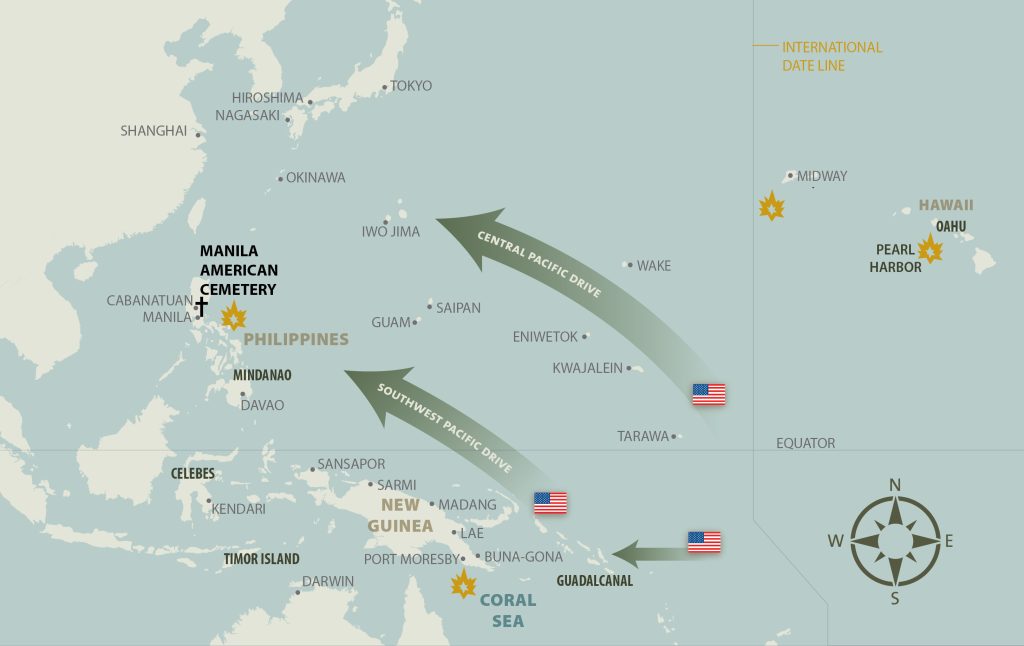
Operations in the Pacific, December 1941 – September 1945
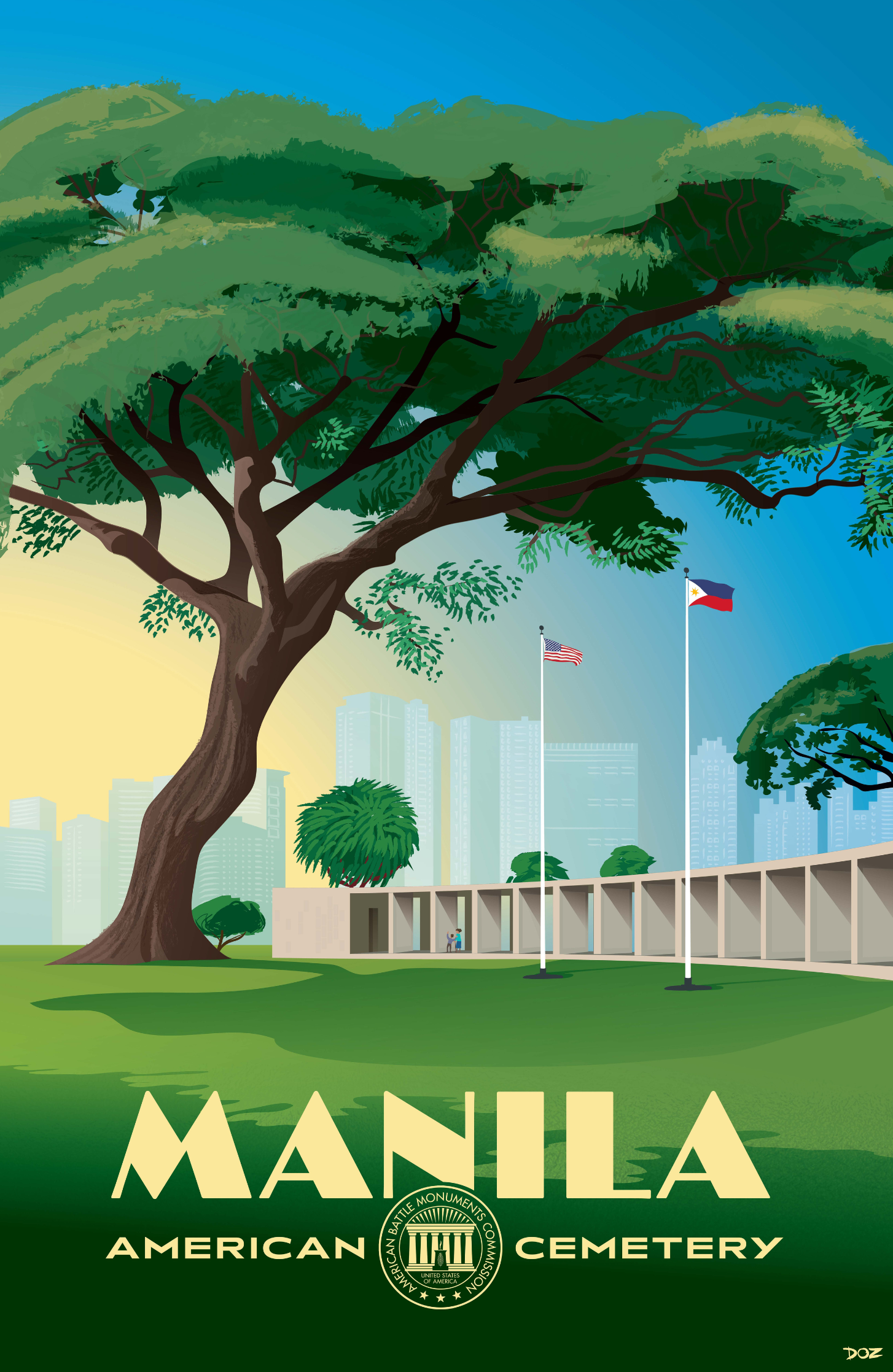
Vintage posters convey the beauty, tranquility, and solemnity of the place as a sign of respect for those who fought so that we can live free today.
U.S. Outlying Islands

Montjoie Saint Martin, France

Cambridge CB23 7PH, United Kingdom

ABMC.gov
official website of the American Battle Monuments Commission and a proud partner of The American Battle Monuments Foundation
Looking for U.S. government information and services? Visit USA.gov
