


Somme American Cemetery

Bony, France
Official websites use .gov
A .gov website belongs to an official government organization in the United States.
Secure .gov websites use HTTPS
A lock
or https:// means you've safely connected to the .gov website. Share sensitive information only on official, secure websites.

Their headstones, aligned in long rows on the 36.5-acre site, rise in a gentle slope from the entrance to the memorial at the far end. The burial area is divided into four plots by wide paths lined by trees and beds of roses; at the intersection are a circular plaza and the flagpole.
The memorial is a curving colonnade, flanked at the ends by a chapel and a map room. It is built of rose-colored sandstone with white trim bearing sculptured details of wartime equipment. The chapel contains an altar of carved stone. Engraved upon its Walls of the Missing are 241 names. Rosettes mark the names of those since recovered and identified. The map room contains an engraved and colored wall map portraying the military operations in this region during 1918.
Oise-Aisne American Cemetery lies about a mile east of Fère-en-Tardenois, which is 14 miles northeast of Chateau-Thierry.
Despite two failed offensives against the British (March 21 – April 30, 1918), Germany launched another assault against French positions on May 27, breaking through the Chemin des Dames ridge and advancing 35 miles south to Château-Thierry in just three days. This created the Aisne-Marne Salient, dangerously close to Paris.
The Allied situation was desperate by late May 1918, leading to urgent calls for U.S. reinforcements. Newly arrived American divisions joined the fight, along with the 370th Infantry Regiment, which was detached to fight alongside French forces.
Germany’s final offensive failed on July 15, allowing the Allies and American Expeditionary Forces (AEF) to counterattack on July 18 with the Aisne-Marne Offensive. Ten U.S. divisions participated, pushing the Germans north to the Vesle River by August 6. The Oise-Aisne Offensive (August 18 – September 16, 1918) continued the advance, further weakening German defenses.
Approximately 310,000 American soldiers and Marines fought in these battles—the first large-scale operation by the AEF under General John J. Pershing. The successes at Aisne-Marne, St. Mihiel, and Meuse-Argonne helped bring about the Armistice on November 11, 1918, ending World War I.
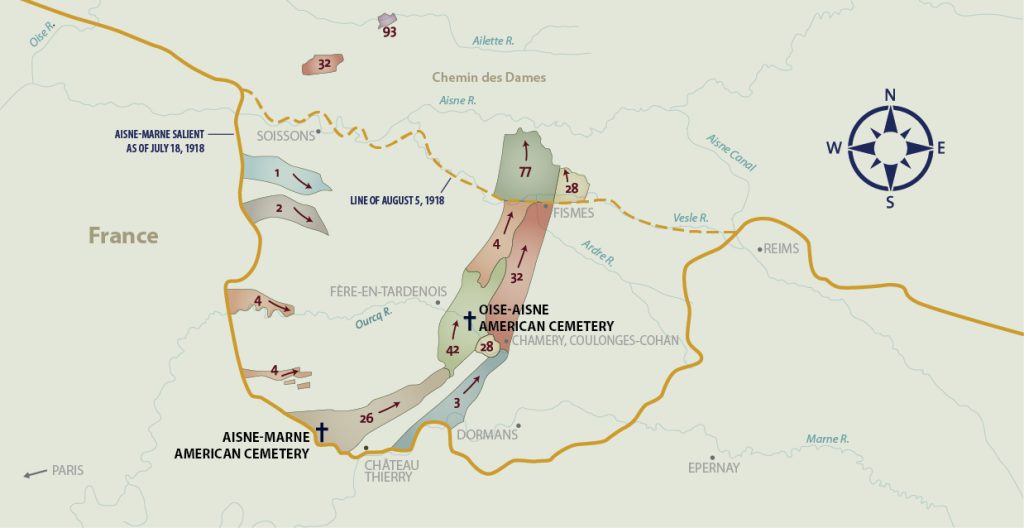
Allied Counterattacks,July 18–September 16, 1918
Vintage posters convey the beauty, tranquility, and solemnity of the place as a sign of respect for those who fought so that we can live free today.

Bony, France

Montsec, France
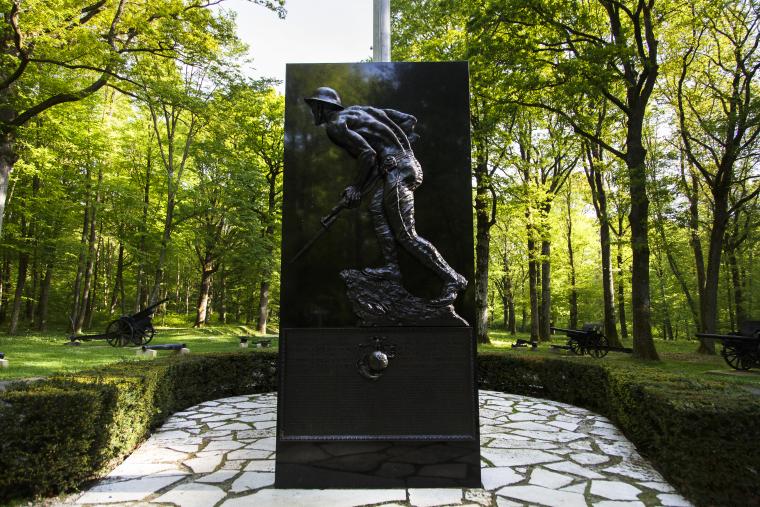
Belleau, France

ABMC.gov
official website of the American Battle Monuments Commission and a proud partner of The American Battle Monuments Foundation
Looking for U.S. government information and services? Visit USA.gov
